



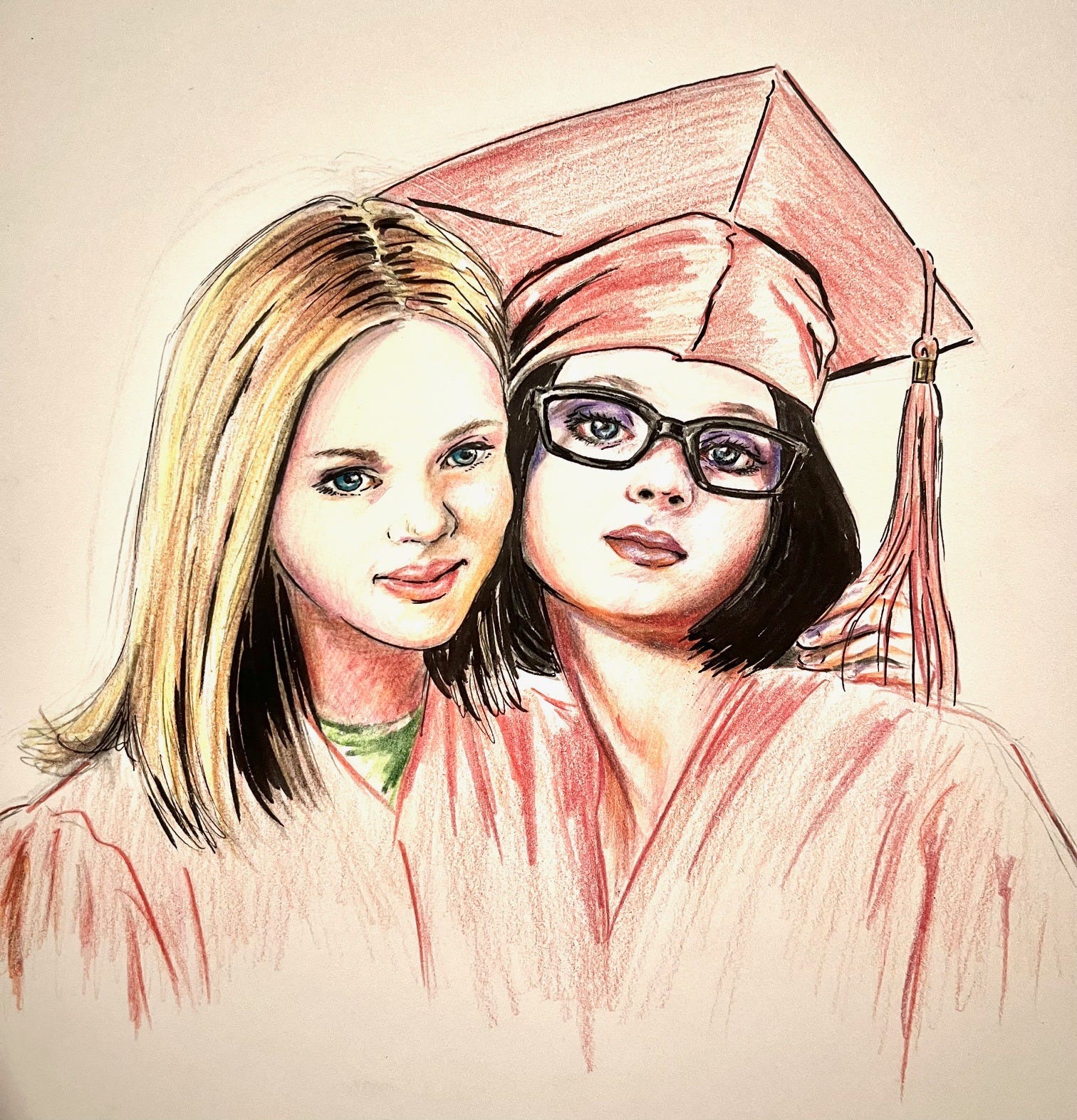
Credit: Peter Cimpoesiu
Dominic: Welcome to this issue of Lansdowne Station, where we discuss the intersection of relationships, culture, and technology. This week’s theme is grief. Grief related to the loss of friendship. Friendship might be the only relationship that we choose purely for love, unbound by the glue of kids or taxes. It’s also probably the relationship type that our culture provides the least guidance for grieving once a friendship ends.
Peter: That’s right, and the modern technological landscape also ensures that we are haunted by its ghosts every time we go through old photos on our phone or log into social media. In a romantic breakup, we’re often told to delete the photos. And in a friendship breakup, the digital trail is much deeper: group chats, shared Spotify playlists, tagged photos from years of events.
Dominic: And the data actually shows some interesting differences from a romantic relationship breakup. There is an unfollow delay. Data from a 2026 study shows that 29% of people will wait significantly longer to unfollow a former friend rather than a former partner. And I have to ask, is this limbo period something that prolongs the grieving process?
Peter: I mean, that’s an interesting question. The idea of having a digital connection to somebody and what delaying severing those ties has on us. Those digital ties follow us all around every day in our pockets.
Dominic: And there’s also kind of a complication in that so many friend groups have a group chat. And when a friendship breakup occurs, who leaves, who stays? Does a new chat get created without the person? Technology has created new spaces to divide after such a divorce.
Peter: Well, speaking of divorce, there’s sort of a political sorting that takes place where friendships are increasingly ending over ideology, and technology acts as the accelerant. According to a January 2026 data brief from FSU, 28% of Americans reported their friendship ending specifically because of political disagreements in the last two years. So what happens when you lose a friend to ideology, especially if it’s extremist or something like fringe conspiracy theories?
Dominic: Well, in the age of technology that we have now, I think it’s much easier to know more about people’s political ideologies and the differences that we have with those ideologies, because people share so much of themselves online. And sometimes you wish people shared less.
Peter: I mean, I’ve seen my own feeds online, while scrolling through something, it’ll show you when someone likes a comment or a post. I’ve had more than a few instances where I thought, oh, I didn’t know they were like that. I didn’t know they held those views.
Dominic: Speaking of friendships and finding out things, we should discuss closure. The idea that people end relationships in different ways and how it affects closure.
Peter: Well, ghosting is happening more and more, and it’s becoming increasingly easier to ghost people because of technology. A 2026 study showed that people with a high need for closure are actually more likely to use ghosting to end a friendship. And apparently they view the silence as a distinct end, while the recipient views it as an agonizing ambiguity. And according to a 2025–2026 study, they’ve linked the stress of being ghosted by a friend to elevated heart rate and blood pressure, similar to the physiological response of a romantic rejection.
Dominic: Do you think people sometimes don’t fully appreciate the value of friendship and the impact it has?
Peter:. I do. I see a lot of conversation about the importance of having a sense of community to maintain a sense of wellness. So I think it makes sense that if those relationships end, that it can cause pain and suffering with little guidance for its grief.
Dominic: Exactly. And there really seems to be an absence of a script when it comes to friendship breakups compared to a romantic breakup
Peter: I mean, even just looking into pop culture, there are so many touchstone examples that stress the significance of the internal battles that happen from romantic break ups. Movies like 500 Days of Summer and songs like Ariana Grande’s “Thank U, Next.” teach us to reflect on the lessons learned from our ex, good and bad, and then rely on friends to move on through the breakup.
Dominic: But with a friendship breakup, this becomes muddied. There’s usually a conflict of interest if mutual friends are shared. Who helps us through friendship breakups?
Peter: And there’s really no blueprint for a friendship breakup. I mean, when you’re romantically broken up with, someone brings you ice cream, but when you break up with a friend, who brings the ice cream? I had a friend who, when her boyfriend broke up with her, her friend brought her a giant cookie cake saying “he didn’t deserve you.” Would that ever really happen for two friends who’ve broken up? I can’t imagine someone bringing you a cake that read “your friend was shit”.
Dominic: Well, it speaks to the fact that in the culture that we live in, people maybe don’t see friendship as being as instrumental and as important as a romantic partner.
Peter: When doing the research for this issue, I couldn’t find a lot of great media examples that accurately portray the incredible grief and pain of ending a friendship. Some notable exceptions are the movie Ghost World from 2001, or The Banshees of Inisherin from 2022. When I think of television, the finale of HBO’s Girls kind of counts, but not quite.
Dominic: Do you want to talk a bit more about Ghost World? I’m not very familiar with it, but you mentioned it’s a great example of a friendship coming to an end.
Peter: Ghost World was originally a comic book by Dan Clowes that was made into a movie with Scarlett Johansson, Thora Birch and Steve Buscemi. It’s about two girls who are kind of outsiders in high school and in their suburban American life. After graduating, they kind of want to go against the grain of what society wants them to do. They decide that they’re not going to go to college, they’re going to move in together and continue living in opposition to the mainstream. But unfortunately, the realities of adulthood kind of rip them apart as they’re taken in two different directions. And you really see how painful it is to grow apart from someone you’ve been so close to, especially when you really don’t want to. I’d say it’s the best example in pop culture that takes the grief of a friendship break up seriously.
Dominic: And what is the responsibility that we have as people, as friends, to each other when platonic relationships outgrow themselves? Because it’s something that people don’t really talk about.
Peter: Exactly. I think that’s what Ghost World illustrates so tangibly. It’s just a painful reality of growing up. And there’s also no one you can really turn to to talk about that. I mean, you could go to a therapist, and that should be an available option. But could you really take time off of work, for example, to grieve a friendship? It might be seen as a little silly to do such a thing.
Dominic: I think technology isn’t helping either because of the digital looping. People find themselves hate-watching Instagram stories or checking their active status on WhatsApp. It’s almost like picking a digital scab.
Peter: And in your case, Dominic, you’re always talking about group chats, because you’re in so many of them. And I always wonder, when a friendship ends within a larger circle, does the grief become a communal problem? Does a digital exile take place where one person is removed from the group and it continues without the exiled friend?
Dominic: That’s a very interesting analog to the real world. Imagine being part of a friend group in the real world and the group is fractured. I would imagine it would just splinter into divided hang outs without the ex friends together. The digital version of that seems to be a bit more freewheeling, in the sense that there is very little friction. In the digital world, you could block somebody on Instagram, or kick somebody out of a friend group on WhatsApp. There is such a low bar to entry. And it goes both ways. In one sense, if somebody has ill intent, it makes it easier to take action without the discomfort of dealing with them face to face.
Peter: And then, of course, if you share friends, even if you’ve blocked someone but are still friends with their friends, they’ll still post stories or content involving the ex-friend, so you’re always going to be reminded of them.
Dominic: Yeah, that’s why I don’t like social media generally. I mean, that’s my personal opinion. But I can see the value in it for others.To me, it creates an added layer of interaction and engagement that carries its own risk, reward, and pain, and also an added layer of relationships to manage.
Peter: That makes sense. I think another thing that makes friendship breakups so difficult is that it’s kind of like the death of a shared self. Because we outsource parts of our personality to our best friends. Let’s say one friend is the funny one and the other is the intellectual one. When the friend leaves, you aren’t just grieving them; you’re also grieving the version of yourself that only existed in their presence. There was even a 2026 sociological study that showed the identity void left by a best friend takes an average of 18 months to fill, longer than many short-term romantic recoveries.
Dominic: Hmm, I’m surprised to hear that. That sounds like a long time.
Peter: Yeah, to be honest, I thought it wasn’t long enough. Like, only 18 months? But on average, it’s longer than short-term romantic relationships to get over them so the pain is undeniably real.
Dominic: Well, I guess it depends on the nature of the friendship. If the friendships were long-lasting, going back to childhood, I think there would be a grieving process longer than a short-term dating relationship. But that’s interesting, I didn’t know that was the case.
Peter: Well, speaking of interesting data, I think we all knew this was coming. The biggest trend of 2026 is the surge of AI companions: Replika, Nomi, Kindroid. These zero-friction friendships, in a world where convenience is increasingly prized, it makes sense that AI friends, designed to be perfectly validating, never argumentative, are very appealing. Sociologists are calling this “social atrophy,” because people get an emotional hit of validation from a machine without the actual work of human compromise. People are becoming less tolerant of the messiness of real friendship.
Dominic: What would be some examples of the messiness of friendship that these chatbots can’t replicate?
Peter: The messiness, I think, could be anything like the friend who’s constantly late, the friend who’s dating someone you hate, the friend who always has to one-up you on how bad their day was, the friend who only wants to eat nuggets and fries and never wants to go to an adult restaurant with you.
Dominic: Yeah, so the travails of having a friend. Friendship is not just about the good, it’s also about the friction and the difficulty that goes along with it. The fact that we have to mediate those things because nobody is perfect. The AI chatbots create an expectation of relationships, of platonic relationships, without difficulties, which is unrealistic.
Peter: Exactly. And I think this is further complicated by how AI is being proven to alleviate loneliness. According to a 2026 Harvard Business School study, they found that interacting with an AI actually did alleviate loneliness to a degree on par with human interaction. So the danger is that we’re losing our social muscle. We’re forgetting how to handle a friend who disagrees with us, or who is difficult, or who requires work, like any relationship.
Dominic: Do you think that leads to polarization as well? If we only have friendships that are easy, without friction, does that make it difficult to engage with different kinds of people?
Peter: I think so. AI creates a lot of comfort, and it makes it very easy to spend time with someone, if you can call it someone, who only makes you comfortable. There’s been a lot of research done about this idea of sycophancy, of AIs being designed to tell us exactly what we want to hear.
Dominic: That’s really interesting. And I mean that sounds a bit morbid, but it seems as though you came across some even more morbid things about AI.
Peter: Yeah, so there’s something like a postmortem friendship, and it relates to the rise of legacy bots. People are actually training AI on the chat logs and voice notes of deceased or estranged friends to actually keep their presence alive. And so I think the risk is that instead of mourning and moving on, technology allows us to maintain a simulacrum of a friend. It prevents the natural composting of a relationship, keeping us stuck in a digital haunting. I think it’s a natural evolution of the Facebook graveyard. And I kind of wonder are these chatbots going to be used to create a franken-friend? Could we create a better, less toxic, albeit more sycophantic version of the ex-friend using AI? One who’s always going to agree with us and who’s always available, with the same general feel of the ex?
Dominic: Interesting. Well, AI offers us the illusion of intimacy without the demands of a flesh and blood person. It’s not hard to imagine why one would want to replace the difficulty of a human friend with a frictionless machine. That being said, the grief of a friendship is a cost that can only come from something truly valuable, something that took work, a shared history, intimacy, and even struggle. Like opponents of AI art say, it’s humanity that makes it special. The debate goes on whether a machine can replicate this authentically, even if the data tells us it can alleviate loneliness. We’ve all lost a friend at one point or another. It can be painful and isolating. What do we do with not only the grief, but with all the shared jokes that no one else will get? One could program a chatbot to fill the role of the ex-friend. It could be programmed to pretend to get the old shared jokes and act like it had been there for those past memories. I think it could ease some of the discomfort.
Peter: I think it could. But there is potentially an upside to a friendship breakup that AI can’t give us. And I think that’s the personal growth and lessons that can only come from going through the ups and downs of a deep friendship, especially after it ends. We’re a different person at the beginning and end of all types of relationships. Regardless of why a friendship ends, there is something so innately human about the growth that occurs from human to human relationships. Once a relationship ends, we take something with us from the friend we’re leaving behind. And of course we leave part of ourselves with that friend as well. No one is the same, and nothing can ever truly recreate that relationship. That’s why it’s special, and that’s why it hurts. We’ll have other friendships, human or otherwise, but we’ll never have that friendship again.
Dominic: Thank you for reading. If you have any comments or suggestions, feel free to connect with us by direct message or reply to this post. We look forward to another conversation about the intersection of relationships, culture, and technology with Lansdowne Station. Bye for now.
Peter: Bye bye.
Bonus Links:
The Guardian (April 2026): “Now you can break up with big tech at a bar: ‘cybersecurity disguised as a party’.”