



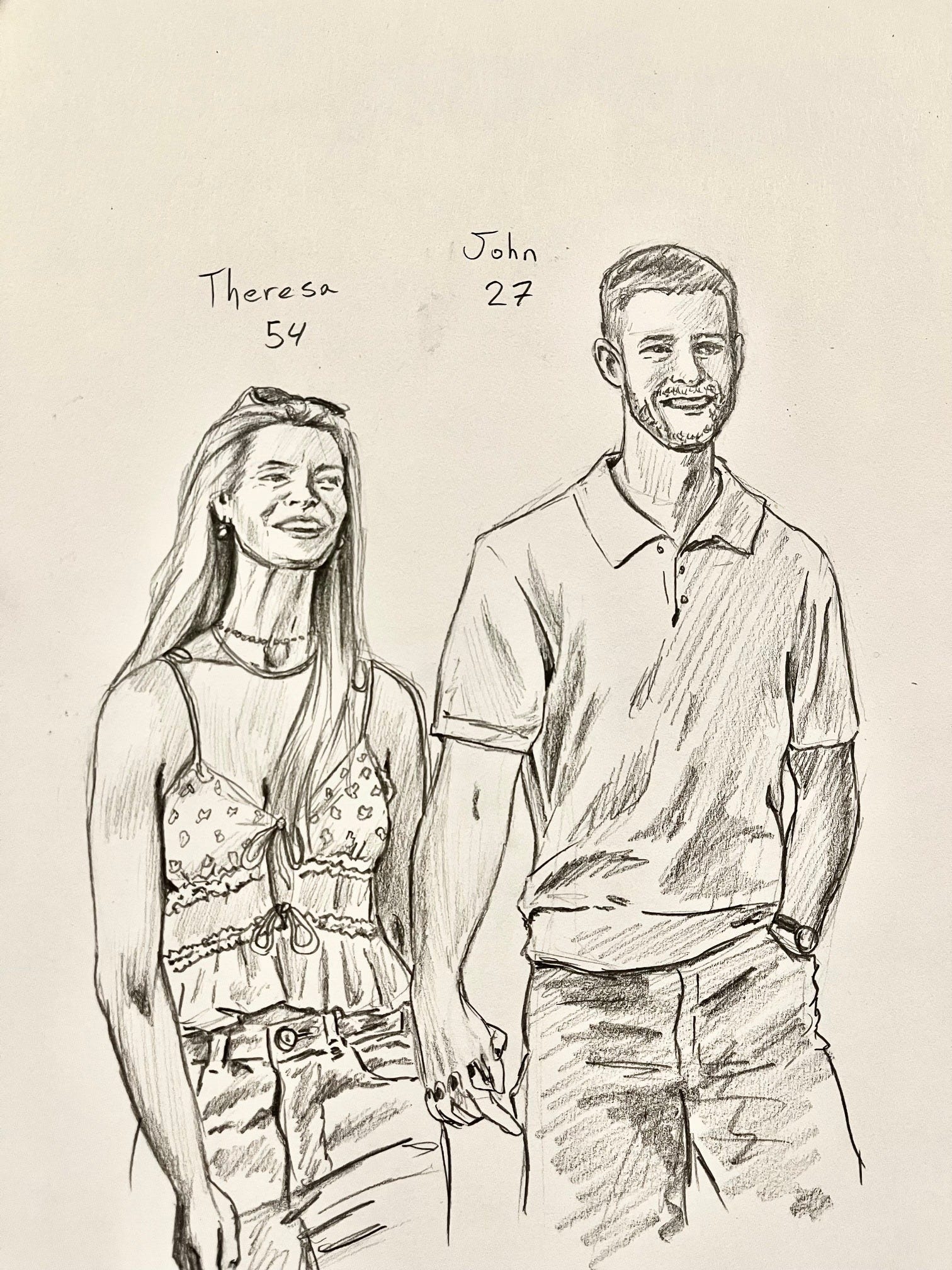
Photo Credit: Peter Cimpoesiu
John Merrill (27) was a contestant on the first season of Netflix’s Age of Attraction (2026), known for his 27-year age gap relationship with 54-year-old Theresa DeMaria.
Dominic: Hey, this is Dominic Alfred. I’m a technology lawyer and writer at Lansdowne Station.
Peter: And this is Peter Cimpoesiu. I’m an artist and writer at Lansdowne Station. Today we’re going to be talking about age gap relationships, particularly older women dating younger men, and the rise in visibility of this once rarer dynamic.
Dominic: That’s right. Welcome back to Lansdowne Station, where we focus on the intersection of relationships, culture, and technology. We had a lot of great feedback from our last newsletter, where we discussed Lindy West, polyamorous relationships and the theme of betrayal. This time we’re going to talk about age gap relationships and the shame that sometimes goes along with them, specifically relationships where there is a significant gap between an older woman dating a younger man.
Peter: The typical dynamic we’re used to is people dating around the same age, or we see older men dating younger women. Now for possibly the first time we’re seeing a significant rise in older women dating younger men openly.
Dominic: Right. We’re seeing a change in the sheer number and public visibility of these couples, as well as in the social acceptance of them. It’s kind of crazy to think there even needs to be a conversation around that. I think there’s a celebrity and media component here. There’s been a shift in how relationships are represented in the media, which ties into something I’m professionally interested in, technology platforms like Netflix and social media. People communicate faster, more transparently, and are much more open about their relationship status. Peter, could you talk about a couple of noteworthy examples of this visibility shift?
Peter: The most striking one is Cher and Alexander Edwards, who have a 40-year gap between them. Cher has always been a powerhouse with several high-profile relationships, most famously with Sonny Bono. It seems like she’s fallen into the role that powerful men like Leonardo DiCaprio are known for, openly dating a much younger partner without shame. She said this is the first time she’s thought about marrying again, and she’s 80. It’s really challenging the public expectations of traditional age dynamics for female celebrities.
Dominic: What other examples stand out?
Peter: Kris Jenner and Corey Gamble have a 25-year gap. This couple is an example of a phenomenon called proxy shame where accusations have been directed at the younger partner, that he’s a gold digger. It’s really a critique of the older woman’s judgment, but it’s interesting to see men being accused of being gold diggers, something long associated with young women dating older men. Priyanka Chopra and Nick Jonas have a 10-year gap, and she does get what I’ve seen called “auntie shaming”, as in calling an older woman who dates a younger man “auntie” as an insult in certain cultural contexts. And then there are recent movies such as A Family Affair with Nicole Kidman and Zac Efron, and then Babygirl; both of these movies show Nicole Kidman as a more visible archetype where she plays an older woman in a relationship with a younger man. These are examples of the increased media and culture visibility we’re seeing. Most notably, in 2026 we’re seeing reality TV shows provide season-long dating shows focused on these types of reality shows. One example is Age of Attraction on Netflix.
Dominic: I wasn’t aware of some of these examples, and even the ones I knew, I wasn’t aware of how significant the gap was. A few years, I rarely saw examples of older women dating younger men (in media or in real life), and when it happened, it was a bit taboo. Speaking of Age of Attraction, the debut season sort of proves that external shame can be a significant risk for these relationships. One of the most popular couples, Teresa and John, had a 27-year age gap.
Peter: How did the reality show Age of Attraction work?
Dominic: People of varying ages meet at a retreat in Vancouver without disclosing their age until they make a commitment to each other and after dating for a short period. When they decide to commit to each other, they do so one-on-one in a room where they exchange rings as part of the commitment process, and then each person in the couple has to disclose their age to one another. A lot of contestants were shocked or pretended to be shocked, when the ages were revealed. The reason we bring up Teresa and John is that he professed his deep love and affection for Teresa and swept her off her feet, but we saw her persistently grappling with shame—she kept talking about what her community, family, and friends would think. These relationships aren’t just a product of the two people involved; all relationships are impacted by the environment and social context they exist in.
Peter: She almost seemed ashamed to be seen in public with him, and she was very afraid of what her kids thought. Her kids raised an eyebrow but seemed mostly okay with it. It really seemed to be just her being so afraid to step out into the real world with him, which is interesting coming from someone choosing to appear on reality TV. I think we should also go over some data measuring the “shame tax” in these relationships.
Dominic: Given there’s a social component based on subjective feelings and beliefs, it’s a good idea to ground this in research. So what does the research say?
Peter: According to ResearchGate 2026, there’s a 10% shame delta. Basically, 74% of people accept an older-male, younger-woman coupling, but only 64% accept the reverse.
Dominic: What does that tell you about the acceptance gap?
Peter: I think 10% is a big enough number to ask why there’s such a gap between it being okay for an older man to date a younger woman, but not the reverse.
Dominic: I actually would have expected the gap to be wider. Maybe 74% versus 64% is a sign of progress? The impact of media and tech, people being more open and transparent, feeling confident and brave enough to love who they love. To pivot but stay with the data, remarriage seems to be the biggest thing affecting these choices. Can you talk about that?
Peter: Newly remarried women are four times more likely to choose a younger partner. 11% of them, compared with just 3% in first marriages. So shame seems to be a first-marriage phenomenon. And you mentioned technology. I do think that’s a big part of this because of the dating app evolution. Age is being replaced by emotional intimacy as a top-three search priority for Gen Z men on Hinge, according to a 2026 study.
Dominic: I’m curious about emotional intimacy. Is that a category on the Hinge app that people can look for? It would be interesting to better understand how age factors in as a selection criterion and now it’s evolved to emotional intimacy.
Peter: The way I interpret emotional intimacy is this: on TikTok and other social media, people constantly complain about problems in dating because it’s hard to find good connections. There’s ghosting, people feeling taken advantage of, people not opening up. In these age-gap pairings, at least for some people, that’s a fix. A lot of younger men are seeking a high emotional vocabulary and reduced anxiety, traits that are statistically more common in older women.
Dominic: That ties nicely into the next topic, why is this age-gap reversal working? Why do these relationships with older women and younger men work so well?
Peter: A few reasons. As women’s earning power grows, they no longer have to rely on men the way they used to. And younger men report less conservative views on traditional relationships and gender roles, so they don’t feel the same kind of shame if a female partner out-earns them. They don’t have to be the provider because they’re making less income, and they don’t feel that pressure.
Dominic: Does that tie into attachment theory? That’s something I’ve heard you talk about. Does it tie into why men seek older women?
Peter: I think so. From the data, 60% of young men report low dating confidence. That can relate to attachment theory. An older woman’s certainty acts as a safety net, allowing for more authentic self-expression. So if a man is more anxious, this might appear more normal to a woman who’s older, who’s maybe worked on her attachment style, or who’s just more emotionally intelligent than someone younger. I would imagine people become more securely attached as they age or at least I hope that’s the case.
Dominic: And what about the sexual dynamic, the match between an older woman and a younger man from a sexual intimacy point of view?
Peter: That’s where things get fun, because there’s a match myth. Both genders report higher satisfaction with younger partners, which I think is due to aligned peak energies. From the data, older women actually get a resurgence in their sexual vitality. It reminds me of an old 30 Rock episode where Liz Lemon talks about being in the tail end of her “dirty thirties.”
Dominic: Dirty thirties—that’s so funny. So what you’re saying is it works well even in an unexpected way. It works for the people doing it, and that’s why they keep doing it, and why we’re seeing more of it. Are there any health implications to this?
Peter: Yes. Older men are coded as providers, whereas older women are coded as predatory, the cougar trope comes to mind. This forces them to internalize invisibility. There’s also a motherhood projection, a major source of external shame is desexualizing a mom, which is used to punish women for having active desire as they age. And there’s a longevity paradox data: while men live longer with younger wives, women with significantly younger husbands show higher mortality rates, which I think is wild. I think that’s due to the physical toll of caregiving stress and social scrutiny. So unfortunately, there’s a tax related to the shame we assign to these relationships, almost a kind of minority stress.
Dominic: Interesting. In spite of all that stress, people continue to persist. Most people are seeking connection in one way or another. These relationships seem more prominent and appear to be working well for them, and tech and media are surfacing it through niche programming on platforms like Netflix. There’s a niche for everyone now. What’s the cultural significance of this overall?
Peter: We’re seeing a cultural shift of resonance over status, because mature women are moving toward dating equally. A 2026 market report shows they prioritize authenticity at 58%, growth mindset at 32%, and curiosity at 29%. As society and gender roles change, the types of relationships we have are going to change with them.
Dominic: So the big question: is the shame just the idea that a woman’s value is tied to fertility? If a woman is financially and emotionally complete, does a curious younger man actually make more sense?
Peter: For us, we would never tie someone’s value to fertility, and technology is making this increasingly irrelevant anyways. This also ties into last week’s episode with Lindy West and her polycule. I think people like to have a cookie-cutter narrative where one type of relationship fits all, but unfortunately what works for one, might not work for another. What works for Cher and Alexander won’t necessarily work for somebody else. As people struggle in the dating market, and from what I hear from all my single friends, it’s a nightmare out there, opening up your scope and trying different kinds of relationships you maybe hadn’t considered is a good idea.
Dominic: Really interesting perspective. I definitely learned some things. We talked about the celebrity and media implications of why we’re seeing more of these older-women, younger-men relationships. We had a chat about the data and measured the shame those relationships experience. We examined the psychological drivers, why they work, and the health paradox and its impact on people in age-gap relationships. Finally, we tied it up with the cultural implications: why we’re seeing a rise in these types of relationships. At the end of the day, we’re happy for anybody who is happy and means well. We hope this discussion brought a lot of value.
Dominic: We want to thank our readers for all your kind comments, feel free to subscribe and leave us a comment. We received direct messages from people who read last week’s newsletter, and we’re happy to connect with you. Look out for our next newsletter, Lansdowne Station, which covers the intersection of relationships, culture, and technology.
Peter: We’ll see you in the next one.